Design Diary 4. The White Chappel
Part 4 of 8. Read part 1 2 3 5 6 7 8.
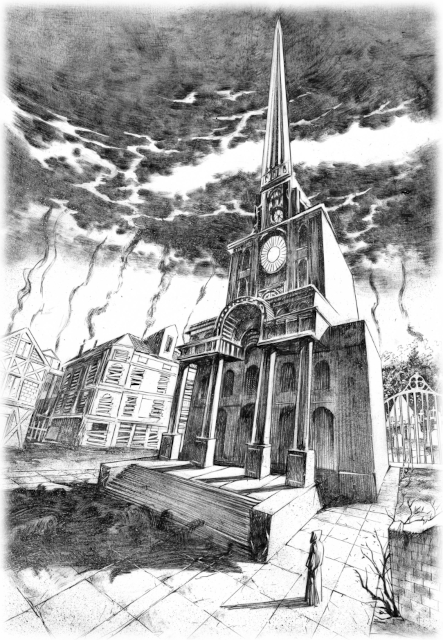
“The White Chappel” is an allusion both to the white Portland stone of Christ Church Spitalfields and to the district of Whitechapel that lent its name to the Ripper murders1.
Christ Church was among the first of the “new” churches designed by Hawksmoor to be built, between 1714–1729. In the 1880s, it still towered over Spitalfields and dominated the skyline.
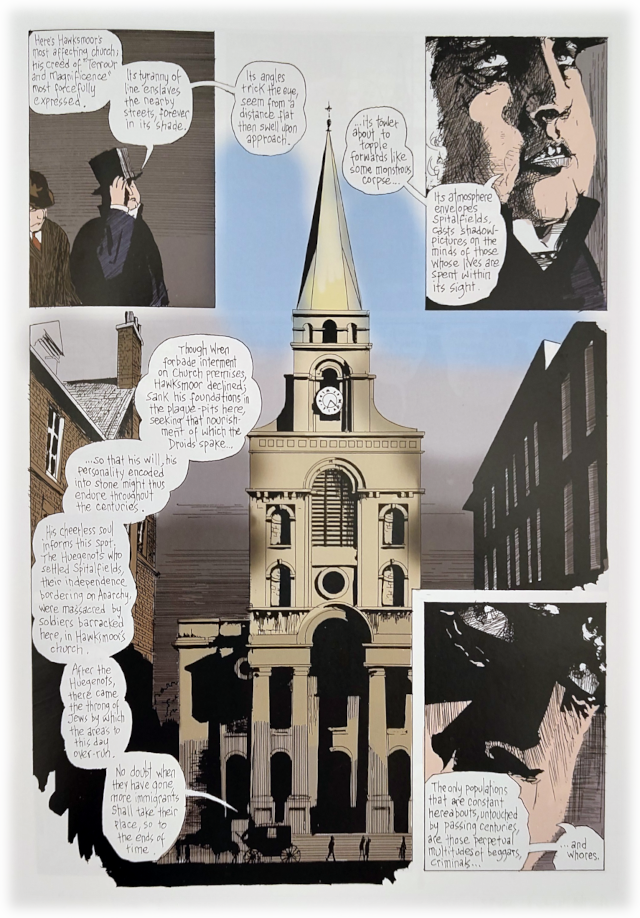
As has already been intimated, the atypical architecture of Hawksmoor’s London churches caught Sinclair’s attention and led to the subsequent mythologising of the architect by Ackroyd and Moore. In Chapter 4 of From Hell, William Gull describes the psychic impact of Christ Church:
Here's Hawksmoor's most affecting church; his creed of "Terrour and Magnificence" most forcefully expressed. It's tyranny of line enslaves the nearby streets, forever in its shade. Its angles trick the eye, seem from a distance flat then swell upon approach… its tower about to topple forwards like some monstrous corpse… its atmosphere envelopes Spitalfields, casts shadow-pictures on the minds of those whose lives are spent within its sight.
Writing in the Architectural Review, Owen Hopkins describes how the occult overtones of Hawksmoor initially provoked outrage within architectural circles — before prompting a reappraisal of his work2:
For Denys Lasdun, Hawksmoor was a sculptor-architect, obsessed by the materiality of stone; for Robert Venturi, he was a pioneer purveyor of architecture that revelled in complexity and contradiction; while for James Stirling, Hawksmoor was a powerful forerunner for his own vigorous compositions of ideas, references and geometries.
It was clear to me that the White Chappel had to be at the centre of Spittle-Fields, both geographically and symbolically. Jason Edwards and I had a very creative interaction (and a lot of fun) iterating back and forward on the cartography. As much as possible, we preserved the architectural features of the real church — the blunt, boxy outline, the steps up to the columned portico, the pillared rectangular nave and the clerestory.
The obelisk-shaped steeple is modelled on the one added by Hawksmoor to St. Luke’s Old Street:
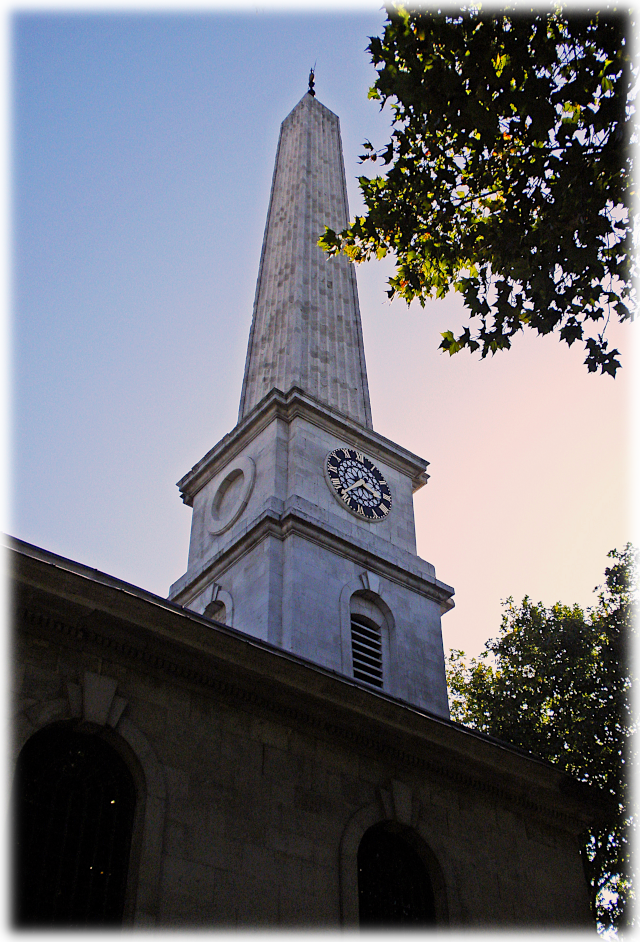
Cropped from original photo by Amanda Slater. License: CC BY-SA 2.0.
The White Chappel is consecrated to the sun god, Ormazd, which seems apposite. As William Gull narrates:
Christ is clearly but the Sun God's latest guise; an incarnation fit for modern times. His greatest feast day coincides with the Winter Solstice, when the hibernating Sun at last begins its slow awakening… While in our paintings still we mark him with a solar disc about his head. Apollo, Lud, Belinos, Atum, Christ or Baal. All one God, Netley. All one God.
The sun’s light is the outward face of the White Chappel, but there is darkness beneath. As Nicholas Dyer puts it, “there is no Light without Darknesse and no Substance without Shaddowe”. Archaeological evidence indicates that Christ Church was built in an area full of mass graves. In Hawksmoor, Dyer ignores Christopher Wren’s prohibition on building near burial sites, constructing Christ Church on top of the plague pits in order to draw on the occult power of the dead. Gull echoes the same idea in From Hell:
Though Wren forbade internment on Church premises, Hawksmoor declined; sank his foundations in the plague pits here, seeking that nourishment of which the Druids spake, so that his will, his personality encoded into stone might thus endure throughout the centuries.
Another dimension of the White Chappel architecture is its stratified layering back through time. It has long fascinated me how Christian churches are often built upon older, pagan foundations. In Geneva (where I live), St. Peter’s Cathedral is built on earlier churches going back to the 4th century, the oldest of which is built on the burial mound of a Celtic hero-chieftain3. I built on this idea by constructing the White Chappel above a temple belonging to the cult of Narrimunâth, Lord of Disease.
The layout of the temple of Narrimunâth is based on the London Mithraeum: in 1954, the remains of a Roman temple to Mithras were excavated in the City of London. This temple is not under a church but in the basement of the Bloomberg building. It amuses me to think that this modern temple to Capitalism is drawing on the power of an ancient pagan cult.
This post is an excerpt from Return of the Ripper Appendix N: Inspirational Sources.
Part 4 of 8. Read part
1
2
3
5
6 7 8.
Notes
1. This is my own conceit; historically, the name Whitechapel predates Christ Church by some five hundred years.
2. Nicholas Hawksmoor (c.1661–1736) by Owen Hopkins, published in The Architectural Review, April 2016 (paywall).
3. See Archaeological Site of St Peter's Cathedral, Geneva.